
Audio article narrated by OpenAI
This article is the second in the column called Change Order.
This operates as a separate monthly column on Last Week in ConTech, which readers can opt in to receive here.
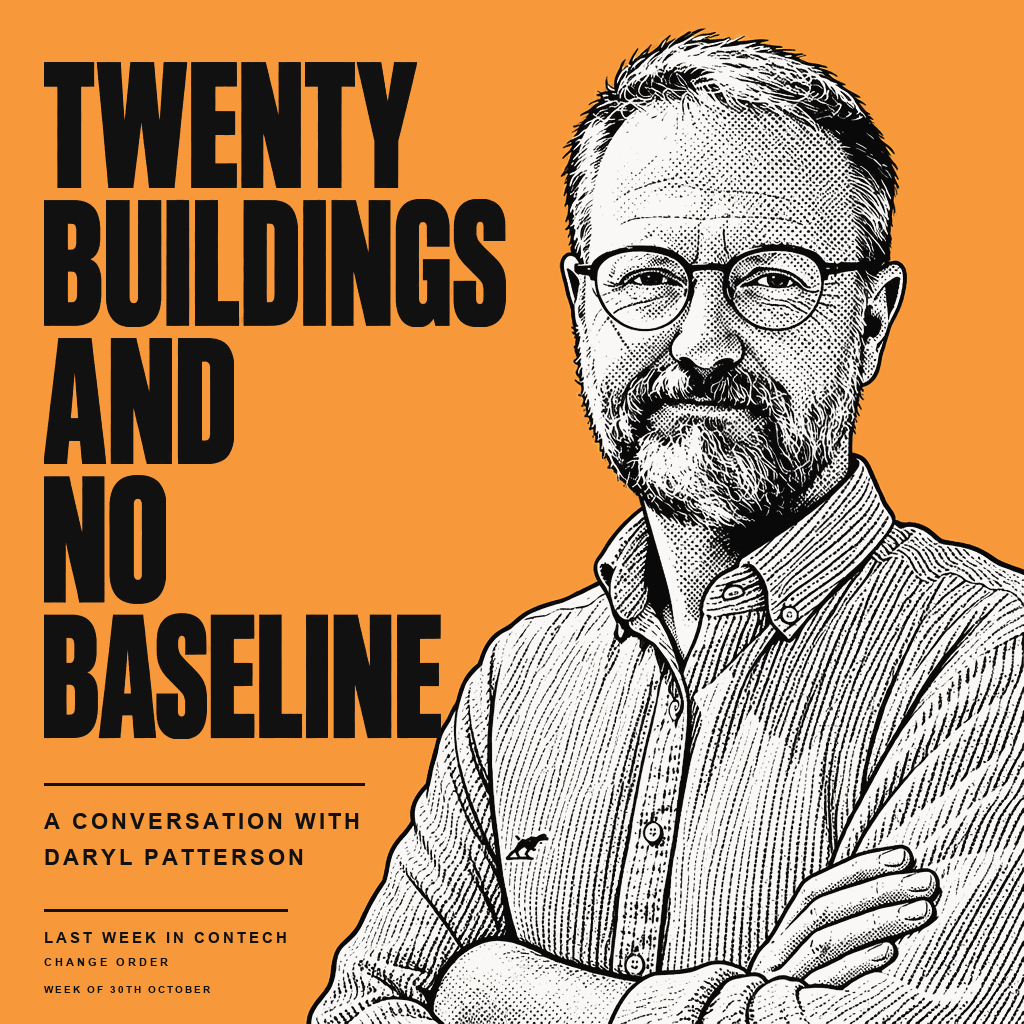
This conversation is with Daryl Patterson
About Daryl Patterson
Daryl Patterson is Chief Product Officer at Building 4.0 CRC and technical lead on System 600, an open-source kit-of-parts interoperability standard for multi-residential housing that began inside the Homes NSW modern methods of construction programme and received $39.3 million from the Commonwealth in May 2026. He took a Bachelor of Architecture at the University of Auckland and spent 28 years at Lendlease across construction, development and digital: four internal start-ups, a national procurement function, the Innovation Lab, cross-laminated timber introduced to a country with no code path for it, and a final posting as Chief Product Officer and Head of Design at Lendlease Digital, where he co-originated Podium. He is now also an Adjunct Professor at Monash University, a partner at Black Oak Group and principal of West Island Workshop. We spoke on 1 October from his house three hours north of Auckland.
—
We’re all kind of obsessed with the making technology before we figured out the product.
Daryl Patterson
—
He is the technical lead on Australia’s most heavily publicly funded industrialised construction programme, which is awkward because he thinks the current wave will mostly fail.
Still in the playthings era
I sent Daryl a link to Gerard de Valence’s survey of Australia’s modular build-out and asked him if 2026 is the tipping point.
The scale isn’t in doubt.
One factory alone—Wesfarmers and Built in Western Australia—has drawn $220 million in funding, and every state now runs a modern methods of construction procurement stream.
He replied that on the balance of probabilities, most of these companies won’t succeed.
It isn’t because the problem isn’t painful. The industry wastes too much, has cost overruns and shortages of skilled labour. His doubt is about the timing.
It’s like the nascent automobile industry between sort of 1885 and 1915, the first 30 years. The car got invented, and some really great cars were built. But it didn’t reach a tipping point where cars were for mass consumption until the method of production got really redeveloped as mass production for the Model T. So you had a 30-year period where literally thousands of companies were building cars, but they were playthings for the wealthy.
Some early cars were excellent. They just weren’t accessible because no one had worked out how to build one at a price most people can pay.
De Valence’s ledger notes two Australian failures this year, one of them publicly funded. Britain has investigated this further after a string of prefab collapses in 2022 and 2023, including Tophat, backed by the UK government’s push for 300,000 homes and Goldman Sachs. The House of Lords inquiry concluded that one reason the companies failed was insufficient orders to keep the new factories running.
The lesson wasn’t factories
The industry went looking for a model but took the wrong lesson from it:
A lot of people from construction looked at automotive and said, automotive, aircraft, washing machines, whatever. All these industries are great, but they have something in common. They have factories. So, you know what, if we have factories, we’ll be like them. And I think that’s a poor lesson to take. The lesson for most of those industries was that they developed products. Products that could be industrialised. They figured out what a car was before they figured out how to mass produce it.
The lesson is product first, production method second. But construction never settled on what its product is.
For some people, it’s a material. For some people, it’s an entire building. And I think it’s in the middle. I think it’s some sort of sub-element produced in an industrial way and combined into different design outcomes. So you still have design flexibility.
Every industry, construction copies, makes a product that it keeps producing. It’s the same product, iterated on over time like a car, washing machine or phone, with each generation built on the tooling and knowledge of the last. Construction can’t do that because you can’t build exactly the same house or school or hospital.
It means the ambition splits into two strategies:
- You get good at producing easy variations of one solution.
- You get good at producing different typologies from the same factory line.
Daryl thinks the second is mostly wishful:
An MMC solution that works well for a data centre may not have any relevance to a hospital. Or an apartment building and so on and so forth, or it may. But a lot of people come up with the idea of how they want to pre-manufacture or industrialise something, and then they say this is going to work for everything. We’re going to build data centres, and we’re going to build schools. I suspect that’s probably not the case. I suspect we need different solutions for different building typologies.
The typologies differ less in technical difficulty than in the level of client customisation required. Data centre operators care less about what the inside looks like, which is why the sector has been able to standardise supply chains relatively quickly. Schools, on the other hand, are educational spaces that people have strong opinions about. Housing can be even harder, as every owner wants to add their own personal touch. For Daryl, housing is the hardest typology to standardise, yet it’s where the industry has started.
Twenty buildings and no baseline
Between 2009 and 2022, Daryl worked on more than twenty mass timber buildings worldwide. None of it delivered cost savings, because there was never any repetition to bank. Each project was a volume of one, twenty times over, and a learning curve can’t form when the quantity keeps resetting.
We didn’t see productivity ultimately translating into cost savings. And in retrospect, my take was we weren’t working on the problem consistently. We were very opportunistic. We had to be. So we’d start with a residential building, and then we built a library, and then we built an office building, and then we built a hotel, and then we built another residential building. So years went by between the first residential building and the second. It was a different team, it was different suppliers, it was a different design. Everything was different. There were no common details.
You’re not actually coming up with a system that you’re improving project by project, even though you think at the time you are.
Even though you think you are at the time. That’s what should worry anyone currently commissioning a factory, and the system has nothing to catch it.
If you’re not measuring it, how can you improve it? You don’t know whether you’re getting better or worse.
Conventional wisdom says every building is different, so nothing can be measured, but a different building isn’t the same as different work. The product might be custom, but the process is mostly repetitive. Pouring, lifting, fixing, connecting and commissioning recur on every job.
That makes a one-off build a manageable problem, since the variation sits only in the output. Santino Medina’s method at Google is to map the build end to end: every step, how long it takes, how many people, the owner, and where the handoff sits.
We have this enormous bias to action. We’re in the building industry, so we build buildings. And whenever someone wants to start a new technology, it’s like, okay, how quickly can we build the building? The problem is that it often lacks the discipline of deep thinking. And it’s only in retrospect we look back and go, oh, 20+ buildings and we didn’t make them cheaper.
Discrete projects, continuous flow
Building a factory is a high-capex endeavour that requires consistent demand.
Construction projects come along in discrete stages. One day you’ve got a construction project and then maybe you don’t have one for a few months as a business. And factories don’t really work that way. They need a continuous flow of stuff coming through them.
What Daryl highlights is the cyclical nature of construction. The industry has accommodated this with flexible labour that can shift between projects and industries as demand changes. A factory, once built, is tied to its production line and cannot easily adapt to shifts in demand.
To solve this, manufacturers are shrinking the unit. They aren’t trying to repeat buildings; instead, they might repeat a bathroom pod. When I put it to Daryl, he accepted the logic but asked:
Is this third version of this pod more productive than the first version? This relies on the pod being consistent, that you are building the third version of the same design, not a radically different design each time. And that’s not how most of the MMC players have set themselves up. They’ve set themselves up to do full customisation.
It’s a lesson he has paid for personally.
He worked with one of four internal startups at Lendlease, a modular bathroom initiative, and his takeaway was that unless you can standardise and scale, you won’t get the cost savings you’re aiming for.
The problem construction faces is that other industries, like manufacturing, haven’t solved true customisation either. Asked which mature, efficient manufacturing industry runs on that level of customisation, his answer was that there isn’t one: “Generally doesn’t. It’s generally about repetition.”
This failure mode isn’t unique; Francisco Maranchello hit an identical wall in software: customise everything for every client, and you’ve built something that can never become a product or scale.
Two companies, two layers, one mistake
In February 2021, as Chief Product Officer of Lendlease Digital, Daryl described Podium—an idea he co-originated inside the company in 2017—as the enabler of the autonomous building of tomorrow, providing a single source of truth for the whole value chain.
This, along with Katerra, was a serious attempt to address the industry’s fragmentation and solve it.
Katerra went after the physical chain, factories, materials, delivery, and contractor acquisition. Podium targeted the information chain with design automation and a digital thread across the value chain.
His diagnosis is that Katerra was “trying to swallow too big an elephant.”
They were buying very conventional construction businesses, design firms, companies that just did stuff the way we’ve always done it. Why did they buy a conventional business when they were supposed to be an innovation machine? I think it was all fallback strategies that, in case the technology didn’t work, they had a conventional delivery model. But the problem is you’ve strapped yourself to all these businesses with all these people who are just behaving in a very incumbent way.
He saw this problem firsthand with Podium.
We sort of had that parallel too because we were trying to pioneer a new digital approach from inside a very successful incumbent player. And that doesn’t work very often in history. Companies don’t like disrupting themselves. And we were trapped inside that business. We couldn’t go find the early adopters who may have wanted to work with us.
Katerra bought incumbents and inherited their behaviour, while Podium was built inside one and couldn’t escape it.
Podium became what he described in his own image.
If you compared it to the solar system, if you said the original platform was the size of our solar system, then what they’re building today is kind of like one moon. And maybe that moon is valuable by itself, but it doesn’t have that context of that solar system to live within that we had originally planned.
He doesn’t disown the strategy: “It’s not that I think I’d go back and reject the strategic thinking that we had in place then. It was just a monumental effort that we didn’t have a way to actually deal with.” The mistake he does name is an amputation. The original concept tied design automation to physical componentry, and the physical half stopped.
We started to think just about design automation and the physical component set kind of stopped. You can rush the front end of the construction process. Say, look, we’ve done the drawings, we’ve got a model, it’s all digitally solved. And then you still have this really expensive, inefficient construction process. So it’s sort of like the juice isn’t worth the squeeze.
Then the reversal, stated plainly:
My thinking’s flipped the priorities now. It’s like you have to have these product and production solutions that you can then automate as much as you like. But starting purely from the digital front end with no physical reality to it, it didn’t change the sort of financial calculus of projects.
That is a reversal most people in his position never make out loud. He made it after leaving: twenty-eight years inside one of Australia’s largest developers, and then conceived a standard built so that no company can own it.
The metadata is the kit
System 600 is an open-source, kit-of-parts prefabrication and modular housing platform pioneered by Homes NSW and Building 4.0 CRC, where he is the technical lead. The idea is to decompose buildings into standardised, interchangeable components such as walls, bathrooms, and kitchens; Daryl believes the ‘middle’ can be productised.
By open sourcing the system, independent manufacturers can supply compatible pieces that click together on site. It’s necessary because it solves the cold start problem.
\[Contractors\] can’t be committing on the first day of a project to a supplier with a proprietary system. The problem with that is if you’re not working with an MMC supplier on the first day of designing the project, the chances of their system being efficient and working for that project are incredibly low.
You can’t pick the manufacturer early, but if you don’t, the system doesn’t fit. So the rules need to be open-sourced rather than controlled by the supplier.
The industry already does this for some materials.
In the U.S., modular brick dimensions are conventionally based on a 4-inch construction module, with ASTM standards governing allowable dimensional tolerances and quality, while the American Softwood Lumber Standard (PS 20) sets standard sizes, grading rules, and quality-control requirements for softwood lumber.
It’s why, when you buy a brick or lumber from different suppliers, it conforms to the same standards. That consistency lets engineers design buildings around expected components, without needing to know how a proprietary system operates before designing.
Daryl believes the standardised unit could be much larger than a brick or piece of lumber, creating greater opportunities for economies of scale. System 600 aims to identify and open-source these building components, and it started with public money for a straightforward reason: nobody in the industry has a budget for this kind of work. In his words, there isn’t “anyone in the construction industry in Australia today saying, I’ve got budgets sitting aside to do innovation.”
A part is only usable if what comes with it is more than geometry: cost, lead time, installation effort, the standards it has been tested against. That data has to come from somewhere, and it can’t come from finished buildings.
Do you have to go build a bunch of buildings before you have any of this information? And that doesn’t work either, because then we’re treating clients as guinea pigs. So we have a big focus on prototyping.
Measurement has to be bought deliberately, because projects won’t donate it. Which is the third thing the industry doesn’t do.
We need to find firstly some opportunities for genuine research and development. And the industry doesn’t do much of that. And a lot of the research and development that does happen, we cynically look at and say, oh, but it was done by academics, or it was done in isolation, or there are reasons why we kind of reject it. So we’ve got to figure out how to actually do R&D as an industry.
Construction is not the only industry shaped this way. Zach Dell makes the same observation about the American grid, where the system rewarded utilities for building more infrastructure rather than lowering costs, leaving them capital-expenditure organisations rather than engineering ones, with no real research function. Construction has the identical shape. It is an industry organised to build, and an industry organised to build does not stop to find out.
Six competitors in a room
If no single company can carry the research burden, competitors can agree on standards instead.
USB was invented by Intel, but it wasn’t commercialised and rolled out by Intel. Intel grabbed 5 of its biggest competitors and sat them down and said, if we can all agree to use it as our standard protocol for connecting devices together, we have enough market power between the 6 of us; it could become the default global standard.
He isn’t proposing another data standard:
I’m thinking more about physical product collaboration protocols for interfaces and interoperability, where I think we’re weakest. I’m not thinking so much about software.
The interface he wants is how two manufactured parts connect on site and collaboration is the answer.
It’s interesting for a private company to invent a new technology and profit from it. But because no one has enough pipeline to drive an adoption of MMC by themselves, and because the problem’s so huge and complex to solve, it’s just fundamentally going to need some real cooperation between multiple actors.
Exhaustion rather than goodwill is what makes that plausible now.
Companies have tried to manufacture and concluded they don’t know how to do it. An obstacle, however, is the law: de Valence has pointed out that competition law prevents contractors from jointly funding cost estimates and design work, meaning the collaboration needed can’t be paid for.
The opportunity is in public works. These can challenge procurement, contracting and design models in ways private firms can’t and the UK hospital programme and Vancouver’s housing programme are doing exactly that. But they can’t fund the industry forever.
There’s an over-expectation on government that they have such volume of work that it can underpin all of this sort of future activity. I think that’s wrong. I think we should be looking at government to be a kind of seeding of these programs or ideas, not the thing that will carry them forward and sustain them forever.
He won’t even claim government should own the standard in the long run — “I don’t know that government is the best owner of that in the long term” — which is an unusual thing to say about the thing you are currently building with public money.
The loop that erases its own evidence
The industry is famous globally for being resilient to change. It’s hard to drive change through the industry, and if you think you’re going to pioneer some new way of working, well, then you better be super resilient yourself and have lots of reserves of patience and capital.
He spent twenty-eight years being this person, and he watched four things not change, each building on the last.
- The industry doesn’t define its product. It buys production technology to manufacture something nobody has properly specified.
- It doesn’t measure its processes. Without a baseline, it cannot tell whether the technology improved performance.
- It doesn’t experiment. The bias to action means budgets go toward delivering buildings rather than prototyping and testing new approaches.
- It doesn’t collaborate. Every participant learns the same lessons privately, at full cost and years apart.
These feed each other:
No baseline means no measurable savings. No proven savings means no confidence in committing to a production pipeline. No committed pipeline means manufacturers must accommodate customisation to secure orders. And customisation limits repetition, making it harder to establish a baseline and measure improvement.
What needs to exist first isn’t a factory or a kit of parts, but a unit of repetition small enough that several manufacturers can each make it and measured closely enough that each repetition gets cheaper.
Until that exists, the capital will keep buying production technology for a product nobody has defined, and the industry will keep producing beautiful buildings with no compounding learning curve.