
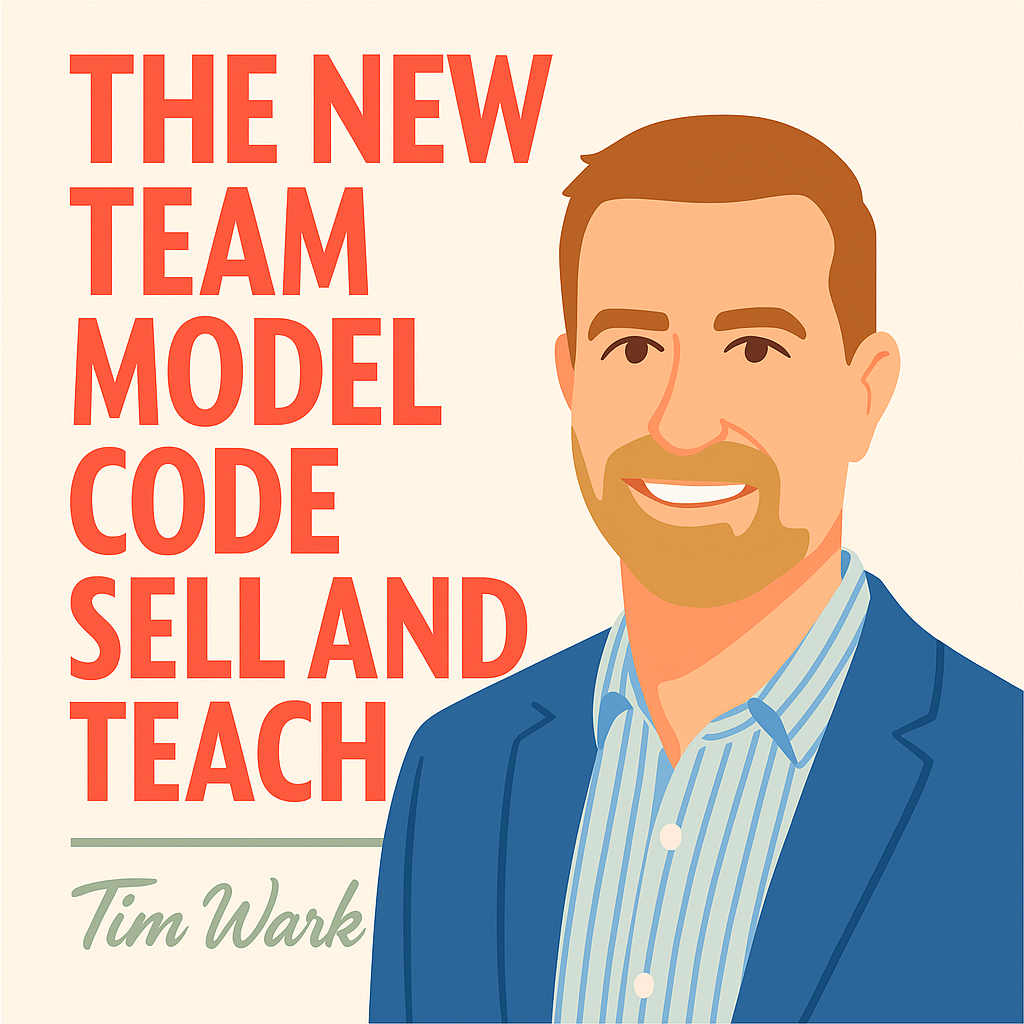
Tim Wark‘s experience deploying AI in mining reveals a surprising reality: when you can quickly develop working prototypes in days, the bottleneck shifts from implementation to understanding the problem correctly. Airis Analytica‘s structure, where each person codes, sells, and teaches, encourages proper product thinking by making ownership unavoidable.
About Tim Wark
Tim is the CTO and Co-founder of AiRis Analytica, a newly growing company launched to drive innovation through bringing together mining expertise with the latest technologies. With over 30 years of experience in technology research & development across a range of sectors, Tim brings fresh perspectives on how to best drive innovation and change in this era of rapid AI investment & growth. From his early days as a PhD student in machine learning, through to leading AI strategy for one of the world’s largest infrastructure firms, he’s a firm believer in the potential of bringing together creative teams at the cutting-edge of new technologies with high-value market problems.
“What is the benefit to prototype very quickly if you don’t understand the problem? The value of having people that can really discover and understand what it means—the discovery process of finding a core issue and a meaningful solution—is something that becomes even more important.” Tim Wark
Tim Wark operates at the bleeding edge of AI deployment in mining, where automation meets three decades of established processes. His experience reveals: AI doesn’t eliminate the need for product-centric thinking; it makes it increasingly the primary sustainable competitive advantage. When you can spin up working prototypes in days, the bottleneck shifts from execution capability to accurate problem understanding.
This creates a counterintuitive market dynamic. The construction industry follows tech’s most expensive pattern: teams optimise for speed while markets reward understanding. Faster prototyping creates the illusion of progress while obscuring whether you’re solving problems that matter. When building becomes trivially fast, competitive advantage shifts to problem framers, not feature builders.
The pricing crisis: from billing hours to capturing outcomes
AI creates a pricing crisis for knowledge work: when some tasks that took 100 hours can now take 10, time-based billing means giving customers a 90% discount despite delivering identical value. The legal industry faces this directly. Criminal barristers using AI tools to dissect witness statements complete in minutes what previously consumed hours of billable discovery work. The value to clients hasn’t changed; the execution time has collapsed.
This forces a fundamental business model shift: from selling inputs (time) to pricing outputs (outcomes). Not “I will spend 10 hours reviewing your contract” but “I will ensure your contract doesn’t expose you to catastrophic risk.” AI assistance collapses execution time but not the value of understanding.
For AEC technology companies, the dynamic proves identical. Time-based billing allowed mediocre problem understanding to hide in implementation hours. Outcome-based pricing exposes whether you understood customer needs or just built something fast. The market punishes poor discovery through production failures and churn.
This mirrors a broader pattern: the difference between outputs and outcomes. Outputs include shipped features, logged hours, and completed sprints. Outcomes are problems solved, customer value delivered, and business results achieved. When teams care about outputs and executives care about outcomes, the incentives completely misalign. Outcome-based pricing forces alignment; everyone cares whether the solution actually solves the problem because that’s how value gets captured.
Micro teams: organisational structure that forces product thinking
The media and software company Every operates with fewer than 10 people, each owning a complete publication from content creation through subscriber relationships to revenue. Tim’s AI company adopts the same approach, adapted for AECO products. The model represents more than operational efficiency; it’s an organisational structure that forces proper product thinking by making ownership impossible to avoid.
When one person codes the solution, owns the customer relationship, and bears responsibility for outcomes, requirements flow directly from customer to builder, and adoption problems surface immediately to the person who coded the solution. The individual either does the discovery work upfront or pays the price in failed deployments and customer churn.
This structure creates three advantages:
Direct customer contact eliminates translation layers. Feedback loops tighten dramatically when the person building talks directly to customers. The developer hears frustration, observes workarounds, and understands context firsthand. The moment when a customer first decides to hire your product reveals causation, what circumstances and alternatives they considered, what job they needed done, and what made this solution compelling—understanding that the initial hiring decision provides more insight than months of feature usage data.
Outcome accountability creates natural feedback. When you own the complete product, you can’t externalise failure. Bad discovery work creates immediate consequences that the same person must resolve.
Rapid iteration based on learning becomes possible. Small teams eliminate coordination delays. When discovery reveals wrong assumptions, the same person who learned this can immediately adjust the solution.
The model works when product scope aligns with individual capacity (AI raises this ceiling dramatically), customer relationships operate on trust more than process (AEC’s strength), and market conditions reward speed over scale (construction technology’s current moment).
Teaching as category creation
But Tim is clear about the challenge: “Staying on the bleeding edge while making changes clear to customers becomes important. There is this teaching part that is also useful to create that trust in the solution, plus the way of the solution is going to evolve eventually in the future.”
This isn’t content marketing; it’s category creation through effective messaging. The challenge isn’t explaining how your product works; it’s helping customers understand the problem differently so they recognise why entirely new solutions matter.
Consider the classic example: Elisha Otis invented the elevator, but no one understood why they needed one. Calling it a “safety elevator” emphasised reliability but didn’t create demand. Reframing it as a “vertical railway” made the category legible. People understood that railways moved people and goods horizontally; vertical railways could enable a new category of building.
Tim faces analogous challenges. AI automation using traditional construction terminology misclassifies the category. The problem isn’t “better dashboards” or “automation tools”, it’s about radical new approaches to reducing risk, optimising capital spend planning or ensuring operational continuity under uncertain conditions. Getting customers to see the problem this way creates space for solutions that don’t fit existing categories.
When a single person educates customers to think about their problems differently, they’re not just selling software; they’re designing the category in which their solution becomes essential rather than optional.
The convergence: why these shifts reinforce each other
These three elements: pricing crisis, micro teams, and category creation through teaching, form a self-reinforcing system. The micro team structure naturally surfaces pricing model weaknesses: when one person owns outcomes, time-based billing becomes absurd because they experience the disconnect between hours worked and value delivered. This forces outcome-based pricing, which, in turn, requires rapid iteration and direct customer feedback from micro teams.
Teaching becomes essential rather than optional in this model. When you price outcomes, customers must understand what outcomes matter and why your approach delivers them. The single owner who codes, sells, and teaches occupies the ideal position to design category language that makes their solution legible. Traditional organisational structures scatter this knowledge across product, sales, and marketing teams, weakening the feedback signal that shapes how categories get framed.
What this reveals about competitive advantage
Tim’s experience exposes three structural topics emerging in AEC technology:
Discovery becomes the core competency that differentiates. When prototyping takes days rather than months, competitive advantage shifts from execution capability to problem selection. Companies that succeed cultivate obsession with customer problems over attachment to solutions. They spend more time understanding problems than building solutions, constantly investigating what pain points customers want solved rather than what product features seem technically impressive.
Business models that align economic incentives with value created win. Time-based billing rewards confusion—companies get paid for iteration regardless of whether they understood the problem correctly. Outcome-based pricing creates discipline around understanding what creates value and whether solutions deliver it. The pricing model determines whether proper product thinking gets rewarded or penalised.
Organisational structures that eliminate coordination overhead become viable. When execution becomes trivially fast, handoff delays and translation layers become the binding constraint. Companies that combine the developer and product owner roles into a single individual who owns the complete product eliminate these delays. The structure works because AI raises the ceiling on what one person can deliver, and AEC’s relationship-driven culture advantages direct customer contact over process-driven engagement.
The construction and mining industries face a structural gap: technological capability has outpaced business model innovation. AI systems automate complex analysis, but billing practices still measure hours. Individual contributors can ship entire products, but organisational structures still optimise for functional specialisation.3
Tim’s example reveals what becomes possible when business models catch up to technical capability: companies build defensible positions through superior problem understanding rather than execution speed, capture more value through outcome-based pricing, and move faster by eliminating coordination overhead. When execution becomes easy, understanding becomes everything. The companies reorganising around this insight will shape the next decade of construction and mining technology.