
Audio article narrated by OpenAI
This article is the first in a new monthly guest column called Change Order.
This operates as a separate monthly column on Last Week in ConTech, which readers can opt in to receive here.
It features conversations with founders, practitioners, and product leaders across AEC about a pivotal decision that shaped a project, product, or business. That could be why the project director chose to change the delivery method mid-project or a founder navigating acquisition by a tech firm.
In hindsight, these decisions often appear inevitable. In reality, they rarely are.
Our goal is to unpack the thinking behind them: what they saw, the trade-offs they considered, who they had to convince, the costs and consequences, and what they would do differently today, with the aim of sharing practical lessons from the people who have faced these challenges before.
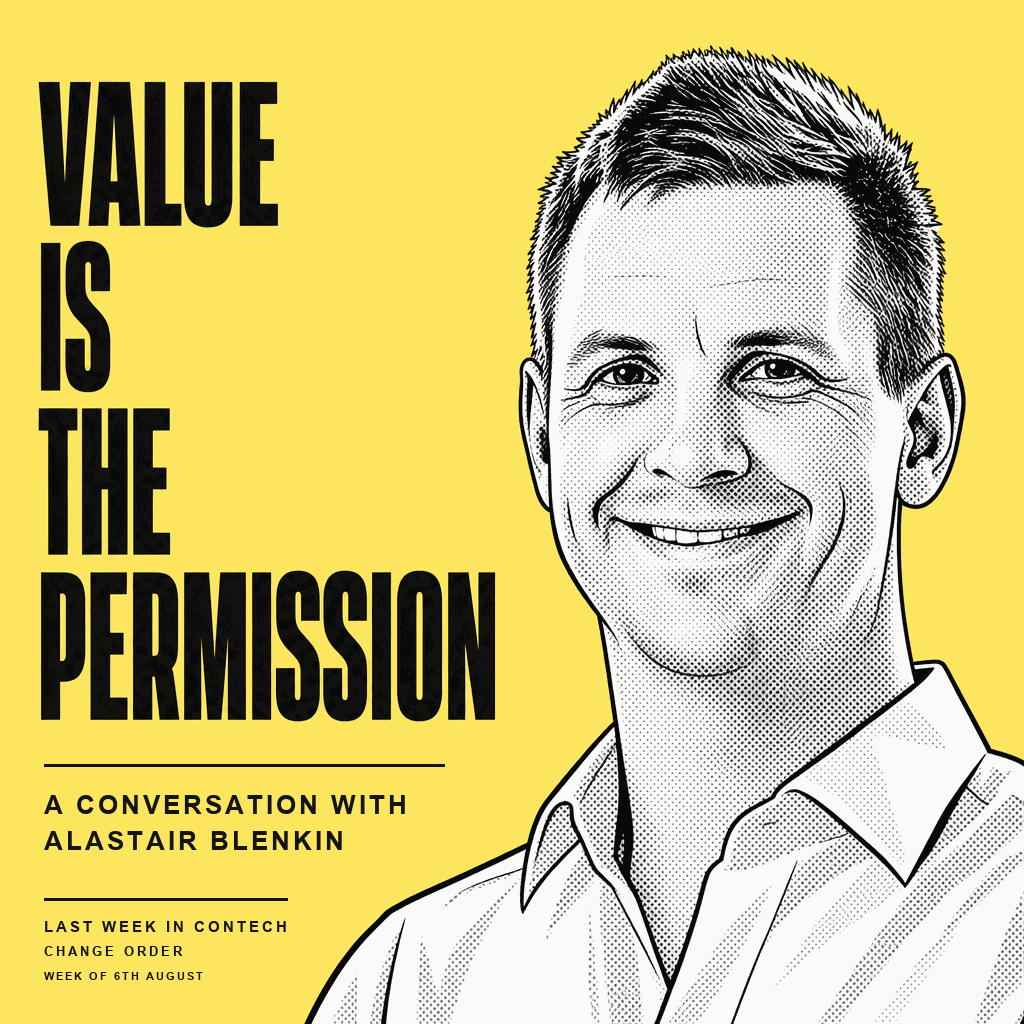
This first conversation is with Alastair Blenkin, founder of ProcurePro.
About Alastair Blenkin
Alastair Blenkin founded ProcurePro in Brisbane in 2020 and now runs it from London, where he moved to lead its expansion through the UK, the Middle East. Before construction, he practised commercial law at MinterEllison and built Hyra iQ, a contract platform for commercial real estate. The company today reports more than $130 billion in construction value processed across 6,000-plus projects, and recently raised $15 million to double down on new AI offerings built on the pricing data it has accumulated.
—
“People don’t buy my software because they like me. I think they like me because my software works and delivers value. If it stops delivering value, they like me less. That is genuinely how it works.” Alastair Blenkin
—
How does construction actually change?
Ask Alastair about construction’s resistance to change and he gives you both barrels.
He talks the way he operates. “People need directness, not indirectness.”
He respects construction and how hard it is to build anything in a financially sustainable way. But in the same breath he’ll tell you the industry is slow to change and works against itself. These are not mummy-and-dad builders sorting out an extension; they are firms delivering $100 million data centres, hospitals, and towers, coordinating dozens of subcontractors, each a separate business on a separate site, under real schedule pressure. Change is harder here, and he has a line for it: it is easier to steer a speedboat than an oil tanker.
What he will not accept is that the difficulty is a reason not to change.
The industry constantly talks about change, but on the ground the reality is different. After building two startups, his conclusion is the answer isn’t enthusiasm, relationships or better technology by itself. It’s providing value the customer can measure.
People confuse interest with value
Every founder pivot gets summarised into one line for the press release. Alastair’s own tidy version, the one he has given elsewhere, is: “2020 COVID baby, we had a company that got killed instantly so we pivoted into what became ProcurePro.” But the devil is in the detail.
He had spent years building his first company, a platform for negotiating commercial real-estate contracts. It had a team, customers, investors, and a product that opened doors. The meetings were good. The pain was acknowledged, the feedback was warm, and the people leaned in. None of it turned into revenue.
The problem was the sale.
A deal would require the landlord who owned the property, the tenants who leased it and then lawyers on both sides. “Put lawyers in the room and people get scared” and scared people don’t sign.
COVID turned the tap off. Two months after launch, the property market simply closed. The reaction he remembers: “Okay, shit. What are we gonna do?”
The product had not failed. But its foundation had crumbled.
At the time, he was already curious about construction, a bigger industry with more contracts with larger dollar figures. He rang a mate who had spent years in the trades and had just come home from a stint overseas. He asked for a day off. That day became a week. That week became a month. And then he had a co-founder.
At ProcurePro, the signal was clearer. Customers would start with a trial project, and within a few weeks be loading their entire portfolio onto the system, signing a three-year deal. Enthusiasm was never evidence. Revenue was.
“You’ve got this positivity around whether it’s working. But in reality you should be intellectually curious: the numbers tell me it’s not working, so why is that, and what do we need to change to make it work?”
Eric Ries gave this discipline a name in The Lean Startup: the muscle of invalidation. When a founder asked Alastair for advice, he told them to read it and then message him next week.
Most people collect proof reinforcing their hypothesis. It’s harder to face you’re wrong and trust the number over your feelings when the two disagree. Onur Ekinci described the same test from the other side of the industry: the question is not whether people have the pain, but whether they will pay to make it go away. Both men have felt the same failure: founders who never ask the paying question, or have one warm meeting and file it as product-market fit.
Finding this is hard. And it all comes down to the speed at which your understanding can compound as a founder.
“How quickly can you learn, and how quickly can you put those learnings into motion and execute? You’re taking signal from everywhere: your business, your customers, your markets, your people.”
It’s worse in a world of AI where there is more noise and it’s cheaper and faster to build. Judgement, the ability to take feedback and consolidate it into product direction and execution, is what he measures again. The opportunity cost of a misstep at ProcurePro’s stage is higher. Earlier-stage competitors copy and pivot faster, while incumbents are able to catch up on features that are working.
It shows up in the way Alastair operates. He has never had a single, consistent mentor. He learns different things from different people and puts them to work in the business. That, in his view, is the difference between the company that failed and the one that succeeded
Build value before the network
He met Leigh Jasper in 2019, a year before the pivot. Jasper had built Aconex, a construction document-control network that eventually sold for $1.6 billion, and he told him: the network effect everyone treats as the prize actually works against you at the start.
Before the network exists, you have to drag several parties onto the product before anyone gets value. For Aconex, it was true. It was built to manage documents, drawings and workflows between independent companies on a construction project. If the architect, contractor or client wasn’t on the platform, much of that coordination still had to happen outside it.
That made for a hard sale, the same multi-party sale that had made his first company so difficult.
So he ran the sequence backwards. Build something a builder finds useful on day one, on its own, and let the subcontractor network arrive later, once there is already a reason to be there.
“The value of the product is not dependent on the network, but complemented by it in time.”
The network, in his phrase, is cream on top. It is a reward for a product that already works, not a toll gate the product has to clear before anyone benefits. It corrects a decade of platform thinking, in which multi-sided magic gets sold as the thing you lead with rather than the thing you earn.
He is not claiming the network-first model never works. Xero built its entire business going through accountants, who brought their customers with them, and it worked. But go back twenty years and ask whether that was an easy sell to the accountants: “no one sees that early part of the journey around, like, how do you get it to work or not.” The model is sound. Founders copying it are copying the finished picture, not the years spent assembling it.
Value creates adoption
Law, where he started, was famously immovable, until AI turned out to be good at drafting and the profession caught fire. Medicine, where his parents work, was just as resistant, until AI note-takers reached the hospitals and clinicians decided they could not work without them.
“If you build something of immense value that’s easy to adopt, people will work it out. It’s human nature.”
That, in his telling, is the opening in construction. His opinion of the software the industry already runs on is self-evident: finance systems built decades ago, large platforms whose product pace slowed as they scaled and very little that feels like modern, consumer-grade software. That gap is the opportunity.
The industry runs on relationships and referrals. A relationship is a proxy for trust, and it is what gets you considered. His claim is not that value replaces relationships, but that it outlasts them. A relationship opens the door and wins you the meeting. Sustained value is what keeps you in the room and drives adoption. Once the product is in use, the relationship rides on whether it keeps delivering, rather than the other way round.
One of his customers, a construction managing director, put it back to him almost as an accusation.
“You guys tell me it’s hard to sell your solution. It’s such a no-brainer.”
It is a no-brainer once you are the person feeling the pain. Getting there is the hard part, and Alastair describes the terrain.
First, you have to earn a meeting with someone who is hounded by vendors all day and whose default is “no” because so much of what they see is crap. That costs six months of hounding them back. Then you crest the first hill and they look at it properly. This looks really good, they say. I know, he thinks. I have been trying to show you for six months.
Then the ground drops away.
The fear arrives: other people in the organisation have to be brought in, the change has to be derisked, and this is where deals die. If it survives, you climb the far side, reach the top, and start implementing. Three months later the phone goes: oh my god, this is amazing, it’s changed my life. I know, he says. I told you three years ago and you didn’t believe me.
ProcurePro doesn’t slot into an existing budget line, because it doesn’t exist yet. Every sale doubles as an education in what the category even is.
Value still needs a mandate
Across more than 270 contractors, the implementations that work are the ones led from the top.
“When your leadership gets up the front of the room, puts the flag in the ground and says this is the way we’re going: you’re either on the bus or off the bus. There’s no excuse in between.”
I think this is where most construction-technology strategy comes undone, and not for lack of enthusiasm. The industry’s stock answer to adoption is to appoint a champion: someone who leans into demos, installs tools on their own time, comes back with use cases, and is handed a title for it.
Maryrose Lyons told the story on the Bricks & Bytes podcast about a firm that had a dozen champions. They met every month. They spun up prototypes. They enjoyed it. Two years on, the construction firm ran exactly as it had before.
Appointing a champion is the beginning of a strategy, not a strategy in itself. Without a mandate from above, and champions don’t have power to restructure. They end up chairing a monthly meeting about tools no one is allowed to deploy. The question isn’t who you appoint; it is how willing you are to restructure existing processes what you are willing to rearrange around them.
To overcome that inertia, Alastair structures his contracts in the customer’s favour: a clause of pure risk reversal that, he says, no customer has ever used. Its value is that it makes the yes easier to say. It is the move the Heath brothers describe in Switch: shrink the ask until a nervous buyer can clear it. Make the first step small enough and the valley stops being fatal.
Some of that commitment has to come from his own side of the table. ProcurePro expanded into the UK before the United States, overlooking the larger market. British procurement resembles the Australian process closely enough that the product needed the least new work to fit, and a smaller market was a lower-risk place to prove expansion. The US remains the bigger opportunity, but the UK was the more practical first step.
When the company expanded, Alastair went himself.
“The biggest mistake people make with international expansion is not sending founders or someone senior enough from the business. You want it done well? You want to show commitment to the market? You go yourself.”
Construction sales carry history, technical detail, and long decisions. A new local team cannot yet hero a deal through on its own. So he moved.
Adoption creates the data
After thousands of projects, ProcurePro sits on what it calls the treasure trove of construction procurement data. Every package priced, every quote levelled, every scope argued over is captured as a by-product of people using the tool. Nobody at those firms ran a data project to make it happen.
“Procurement, if you put your data through a system, the job of procurement means you don’t need to go and update parallel reports. You capture the data at source.”
That reframes the question the industry keeps asking. Everyone says they need good data before they can do anything with AI, and almost nobody can say where to start. His first move is to make the question smaller. Not everything requires good data. ChatGPT doesn’t. Nor does software that structures the data for you on the way through.
What does require it is your own business intelligence, and here he is candid that ProcurePro has the same problem as its customers: revenue targets that differ depending on where you look, no real source of truth. The job is a unified data model, a semantic layer, one agreed language for what a project is, what a trade is, what a budget is, and where the number came from when two systems disagree.
Construction makes that harder than it sounds. A builder runs seven or eight pillars, design, planning, estimating, commercial, operations, safety, finance, and each has its own core system calling the same thing by a different name. One calls it a vendor, one calls it a sub, one calls it a supplier.
His advice is to refuse the whole map. Finance first, then the things that move cost: procurement, payments, project management. Then the 20 metrics that actually run the business, the top three per department, and the supporting ones layered in over time. It is a progressive maturity, not a programme.
The destination is not a dashboard. Business intelligence, the category of tools firms buy to turn their data into reports and charts, is the part he expects to break.
“I really strongly believe the future of BI, as in dashboards and visualisation, is not BI tools. They’re clunky and they always have some limitations. AI is amazing at building using code, so you can get really dexterous around the interfaces.”
Get the layer right and the reporting stops being a product you buy and becomes a question you ask.
AI adoption is a management problem
He is not theorising from a distance. Whatever he thinks the industry should do with AI, he has been running it inside his own company first, and harder than most.
“We say software not salaries. Someone wants to buy a tool? Absolutely, I’ll take a punt on it, because I know the value it can bring.”
The stance sharpens around AI, where it doubles as a hiring filter. A marketer who tells him writing is a craft that AI would cheapen does not get the job. Engineers are expected to be all in.
“If you’re not pro-AI, you’re not a modern professional.”
What is striking is how much of this he still describes as unfinished.
He wants an internal AI competency framework. He has yet to draw a hard line on AI coding. He still needs to hire an AI lead. But his starting point is clear.
It’s about going wide first. Give everyone a sandbox. Let people build. Resist funnelling every request through anointed experts, because a hundred people experimenting will teach you more than a queue ever could.
Then change direction. Once its value is proven, narrow the field. Concentrate.
“Build two agents really well, not 20 poorly. Once you’ve got two working, it’s not build-it-and-leave-it; you give it feedback like you’re managing a staff member. That agent should have a KPI and an owner.”
It’s important because an agent is not software you install and forget. It is closer to a hire, and a hire without onboarding, a manager, and a metric will drift. Automation does not remove management so much as move it, from managing people to managing models.
Dan Shipper calls the emerging role the forward-deployed engineer, on the argument that every agent still needs a human to keep it honest. I’ve made the same bet about construction. I expect the role to grow out of the computational designer role and become a kind of HR manager for AI agents who onboard them, set their guardrails, and garden them as they drift.
On what all of this costs, he is calm. If he pays as much for tokens as for staff and gets the productivity, he reasons, it is a line on the cost base. Today’s prices could fall a hundredfold tomorrow.
In the same breath he admits the number could run to millions. It seems scary right now. If the assumptions underneath a model shifted, he would have to rethink the whole strategy.
This makes more sense when building software than in construction. The two industries are not in the same place. A software company burns tokens to write its own software; the model does the core work, and the value lands in the product.
Construction is not there yet. Much of what the industry badges as AI is a wrapper on someone else’s foundational model, renting premium tokens by the API call for workflows that have not yet proved their value. For now, the token is an additional cost.
For firms, it’s becoming about efficiency. Knowing when to use an expensive model and not to use frontier capability to read two PDFs.
But AI is not judgement
For all the push, he is not pro-AI at any cost, and the line he draws is taste. He does not want AI writing a whole presentation. It strips out the thinking and comes back flat, and, in his words, sloppy. A thought partner, fine. A stand-in for judgement, no.
“AI is not going to come and solve the problem of what good looks like. The humans have got to solve that, maybe with AI. You can’t AI your way to a problem that isn’t already solved.”
The phrase he keeps returning to is what good looks like. Defining it is a human obligation before it is a machine one. If you have not worked out and written down what good is, AI does not rescue you; it scales the mess faster.
In construction, I would put it a little differently. The taste worth capturing is the subject-matter judgement locked inside experienced engineers, and the prize is getting it out of their heads and into something the whole organisation can reuse. But the caution holds. Automating a process you have not yet figured out only industrialises the confusion.
Data creates industry power
Get the data structured and the judgement right, and the model can flip.
Today a builder sends a package out to seven subcontractors, chases five quotes, throws two away, levels the remaining three, and loses weeks to it. Subcontractors price the uncertainty as much as the work. A vague tender, three gigabytes of drawings no one can reconcile, comes back, in his estimate, around 20 percent higher than a clean one. His future runs the other way.
“Based on all my historical data, I think this package, this type of job, this size, in this area, should cost between X and Y. Do you agree? And then the conversation becomes: do you want the job?”
It’s a vision I pushed back against. If subcontractors know their scopes are being read by an algorithm and priced against a benchmark, what stops them from making those scopes murkier to defend their margin?
His response was that confusion is already how the industry overprices, so clarity is the cure. A clean scope is one the sub can price tightly and the builder can trust.
Maybe. Pricing is one of the few levers a subcontractor still controls, and a benchmark built to squeeze it is not something they will help sharpen. He is describing a real shift in power, from the supply chain that has always set prices to the builder, who now holds the data. Shifts in power tend to be argued over rather than accepted. What he is surer of is the nearer prize.
“We talk about commercial people doing commercial work, not commercial people doing administration.”
Take the ambiguity out of the way, and commercial people can interrogate the design and the scope instead of pushing paper. That is where cost and margin move. That part he is certain about. The bigger flip, he is still making the case for.
Value is the permission
Line the moves up and they make a ladder for innovation managers and founders rather than a list.
Value a customer can measure earns adoption. Adoption, at enough scale, becomes data. Data, once a human has provided what good looks like, becomes the power to reprice the work itself. Each rung holds only because the one beneath it did, which is why the order matters.
ProcurePro’s ladder is unfinished. Some of it is settled conviction, tested across hundreds of contracts. The rest is a bet still being placed, with the AI lead unhired, the competency framework a want rather than a system, and the pricing flip still an argument he is making to the market rather than a thing that has happened.
If it holds all the way up, construction gets something it has never had: a builder who knows what the work should cost before the supply chain tells him, and commercial teams spending their days on the design rather than the paperwork.
What runs through every rung is a refusal to wait for permission.
Construction does not hand out permission. It withholds it through fragmentation, risk aversion, and the plain self-interest of everyone guarding their own corner. What it eventually answers to is value it can measure. So Alastair acts first and lets the result do the arguing. He couldn’t sit back and do nothing while broken processes spiralled, and couldn’t accept being told “that’s just how it is.” He’s been operating on that instinct ever since, on the wager that in an industry this resistant, the value is the permission, and it mostly arrives after the fact.